Commissioned by the Board
of Trustees of Blithewold
Blithewold Mansion &
Arboretum
(Happy Woodland)
Future Visions: 20 Years On
~~~
Because it was thought that the general public would not
know what an “arboretum” is, the decision to
change the name from arboretum to gardens was perhaps the
beginning of what has become a skewed perception of Blithewold.
“Arboretum” does, in fact, mean: “a place
grown with trees, a place devoted to the cultivation and
exhibition of rare trees, a botanical tree garden.”
That according to the Oxford English Dictionary. It was
in 1926 that botanists from the prestigious Arnold Arboretum
in Boston, home to Harvard University’s collection
of rare trees, who informed the owners of Blithewold that
their home was in truth an Arboretum.
There certainly is need for thought on revision of the name.
Perhaps we return to a simple “Blithewold”,
and embellish that, when necessary, with a more detailed
description of Blithewold as an arboretum with a handsome
manor house and gardens.
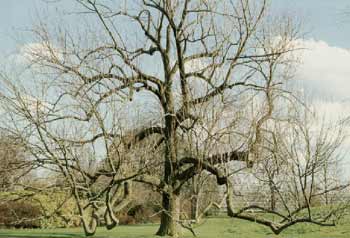
Over the years the thrust of
Blithewold has started to lean more toward the house and
away from the arboretum and grounds. The perception is that
the house is the draw the money maker. The horticultural
aspects of Blithewold are seen to be less of a draw perhaps
intimidating? Or is it that we are timid and unassuming
about what we have, It is commonly thought that people come
first to see the house, and then, second, the grounds. Our
aim is to redress this balance and reinvigorate interest
in the botanical aspects of Blithewold, along with an interest
in the vision of the “horticultural diva” who
was so instrumental in creating this haven, Bessie VanWickle
McKee, who continued the work first begun by the DeWolf
family. And then her horticultural successor, Marjorie VanWickle
Lyon. And what vision Mrs. McKee had, creating an arboretum
while knowing full well that she would never see it to maturity,
but that others would enjoy the fruits of her labors.
Blithewold is a botanical and horticultural gem. Literally,
one of a kind, it is a resource that is sorely under utilized
for not only the horticultural community, but also for the
gardening public, and general public. We need to increase
and revitalize the public’s awareness of what Blithewold
has to offer, botanically and horticulturally.
Gardening is now the number one hobby in
the United States. People are visiting botanical gardens
in ever increasing numbers. Attendance is up at most of
the major botanical gardens Atlanta, Chicago, Brooklyn...
Why do we not think of Blithewold as part of the network
of major national botanical gardens “The Rhode island
Botanical Garden.”
It is time to aggressively rethink why people come to
Blithewold. After all, there are plenty of “mansions”
to be visited so close in Newport.
There are significant differences, however, between Blithewold
and the mansions in Newport Blithewold was the home of
people who did not want to live in Newport even though
they could well have afforded to. They wanted a build
a “home” as opposed to a grand mansion, and
to live on land that could be nurtured horticulturally.
The botanical and horticultural resources of Blithewold
are as historic as they are numerous and varied. They
offer the visitor a rich horticultural experience, leaving
many to return to their homes filled with ideas for their
own gardens:
* Over 1,500 trees and shrubs, both native and exotic,
placing
Blithewold in the same arena as Arnold Arboretum. What
makes it
a little different is that many of the trees retain a
personal history
for the owner of Blithewold.
* A landscape design by John DeWolf that
has survived unchanged
for over 100 years. Parts of this design have become lost
under
growth and need to be retrieved. A challenging but exciting
project
which presents an opportunity for publicity.
* The location is not only stunning, but horticulturally
challenging. lt
presents unique planting opportunities which can be of
special
interest to those with similar planting dilemmas.
* The tallest of a handful of Giant Sequoias on the East
Coast. There
are seedlings of this tree on the property. The care of
this tree was
a passion of Mrs. Lyon.
* A mature Bamboo Grove. A magnet for children and adults
alike
many of whom will never have the chance to see something
as
unusual and exotic as this.
* A huge cutting garden displaying an enormous and unusual
selection of both annuals and perennials.
* A vegetable garden featuring many heirloom species which
are
not familiar to today’s gardeners, but which were
part of the
gardens’ history.
* An elegantly designed rock garden situated close to
the water but
quietly sheltered from the harsh seashore environment
by a grove
of trees.
* A remarkable pond and water garden revealing carefully
chosen water plantings.
* A sweeping 20 acre lawn requiring numerous man hours
of care
and maintenance.
* A trellised enclosed rose garden home to many different
species of roses, both antique and modern, climbing and
shrub.
* Staggering number of planted daffodils which create
the
famous “Blithewold Daffodil Week”. A misnomer.
The
beauty lasts far longer. Hence the institution of “Daffodil
Days” from April to early May.
* A sunken garden to the north of house
“The North Garden”
which is now a graceful border garden but which in days
past
was an elegant formal box garden, perfect for strolling.
* Both formal pathways, and woodland trails lush with
wild plant
material.
* A fully working original greenhouse which, if renovated,
could
become an active and much visited feature on the grounds
tour.
* An existing conservatory, intact but in storage, ready
to be re
erected on its original site.
* An enclosed garden unusual in that it is enclosed by
trees and
not high walls. This is home to the Giant Sequoia, and
to many
other notable trees and shrubs.
* A delightful pet cemetery located in the dappled shade
of the
Bosquet. Home to many beloved pets of the family. This
is an
existing area that has become neglected and remains in
need of
restoration. There are beautifully designed old brass
plaques
designed to adorn the area.
To interest the public again in both the
house and the grounds we need to bring it all into focus.
To tie the two together. To help people place themselves
back in time. To gently pull people into the past and
open their eyes, yet more, to life as it was when Blithewold
was well loved, and lived in.
To do this:
* At the Visitor’s Center there could be an exhibit
of the history of Blithewold. This would catch the attention
of people who had not thought to visit the house. Such
information could also reinforce the botanical and horticultural
side of the property.
* Place elegant informational signs at strategic points
around the property to remind people, visually, of what
Blithewold used to looked like.
At the beginning of the tour present a rendering
of DeWolf’s initial landscape design. Alert people
to the fact that the property extended far beyond its current
boundaries. The House stood in the center of the property.
At the approach to the greenhouse from the
Enclosed Garden restore the pathway to the site of the conservatory.
At the end of the path place a sign displaying an existing
old photograph of the conservatory as it once was. Give
information about the conservatory, and the fact that it
does currently exist and awaits funds for restoration. The
site could be plotted out with wooden pegs and white rope.
This is an ideal opportunity to remind people that there
is a fund raising drive to restore the conservatory.
At the lower end of the vegetable garden present walkers
with a sign displaying an artists’s rendering, or
photograph, of what the cutting garden used to look like.
There was no lawn the entire area all the way down to the
water garden was a working garden used to feed the family.
Somewhere near Lover’s Lane display a sign showing
what the dock used to look like. This would also let people
know that the family used the dock often to swim, kayak,
canoe, or get out to their yacht moored close by.
* Design an exhibit of garden tools such as those used
during the active time of Blithewold.
* Publicize the beauty of Blithewold in the Fall. Urge
people to continue their horticultural interests and pursuits
well beyond the “garden clean up” time by
coming to see what is still happening in the gardens:
From September 15 to November 1st we should institute
a well publicized “Fall at Blithewold”.
* There are opportunities in the quarterly newsletter
to interest people in the history of Blithewold:
Historical photographs along with footnotes could be printed
every month.
Alice DeWolf Pardee’s book Blithewold could be reprinted,
a part at a time, in the newsletter over the course of many
months. This would pique interest in the history.
Print articles about what was happening in
surrounding areas at the time the VanWickles and McKee’s
lived at Blithewold.
Create general interest articles in association with the
Bristol Historical Society.
Educational Opportunities
As a resource for horticultural education Blithewold offers
innumerable opportunities:
* Create The Horticultural Center at Blithewold, to be
located in the North Cottage. This would be a center with
offices, classrooms, workshop space, and a horticultural
library.
* A simple labeling of all
plant material. People who visit botanical gardens go
there because they want to learn about the plants. You
do a disservice to those people if plants are not labeled.
* Hold Garden Symposiums, much as Horticulture magazine
offers. Day long or weekend long symposiums offering workshops,
lectures, tours, hands on laboratories. Held spring or
fall.
* Create a working apprenticeship program whereby students
would pay to work at Blithewold, alongside the horticultural
staff
* Students of horticulture, botany, plant sciences, or
landscape architecture and design would receive college
credit for working a semester at Blithewold.
* Horticulture Certificate program, modeled on that offered
by Longwood Gardens in Pennsylvania.
* Offer courses in garden history and preservation. Blithewold
is a living example of history in the garden.
* Using Blithewold as a living laboratory create educational
programs for elementary, middle and high school students.
Design a brochure specifically targeted to schools advertizing
this program.
* Encourage school field trips to Blithewold. Ask the
children to write essays or create art work about their
horticultural experiences while on the property
* Create a Children’s Nature Club, in association
with the Norman Bird Sanctuary, 4H, and the Audubon Society
at their soon to be built center in Bristol.
* Build on our educational relationship with Roger Williams
University. The University boasts a historic preservation
program, an architecture degree, and incorporates many
landscape architecture courses into their degree program.
* Encourage the public to visit Blithewold to get ideas
for plantings on their own property. If they are thinking
of purchasing a tree, suggest they visit Blithewold first
to see mature specimens. Offer advice on their purchase.
* Botanical & Horticultural Summer Camps for older
children.
* Better publicize the Plant Sale of 500 annuals and perennials,
many of which are unusual and hard to find.
* Offer regular on going courses
in horticulture, utilizing teachers from throughout the
State, as well as surrounding areas. UP] has many teachers
of plant related subjects. Invite Master Gardeners from
the URI program to teach.
* Create a Horticultural Library.
* Have garden staff on hand to answer questions, even
at the weekend. This could be in collaboration with the
Rhode Island Master Gardeners.
* Garden Staff could be in a simple, working uniform such
as a T Shirt or Sweat Shirt that identifies the member
of staff as such.
Horticulture in the Newsletter
* In the quarterly newsletter there could be a regular
column: “Garden Cuttings” informing readers
of what is happening in the garden. In addition, there
could be light hearted Profiles of Garden Volunteers,
quotes and snippets from members about their favorite
garden tool, favorite garden shoes, favorite plant, favorite
planting medium, least favorite of same, and more...
* Regular photographs of horticultural activities in the
garden: tree pruning, fights with the aegapodium, renovation
of a lilac, etc.
* Photographs of children in the garden, i.e. with the
gourds which are twice as big as the children
Horticultural Gift Shop Ideas
Make the Gift Shop a real resource for gardeners, such that
gardeners would travel to Blithewold to shop. Apart from
items that are specifically created from Blithewold such
as: boxed note cards featuring photographs of the grounds
through the seasons. Views, and close up shots of specimen
plant material. The shop could stock more serious gardening
books, more serious garden tools, botanical prints, unusual
terracotta planters.
Rather than a T shirt that features the mansion, we could
create an emblem that emphasizes something horticulturally
unusual and easily identifiable as Blithewold. For instance,
the Giant Sequoia pine cone with its unique and distinctive
shape.
Addendum
There has been a notable lack of horticultural strength
on the Board of Trustees. Perhaps
it is time to recruit people who know and understand horticultural
matters.
Create an active Horticultural Advisory
Board to assist the Blithewold Staff in horticultural endeavors.
This Board, made up of prominent horticultural notables,
could be the liaison to the Heritage Trust on horticultural
matters.
Could we make Blithewold home to a revived Rhode Island
Horticultural Society? Possibly in association with the
very active Rhode Island Wild Plant Society.
First, we must bring back what has been lost in the landscape.
Also, we must preserve its history. But, then we need to
ask the question: do we simply replace the plant material
that been here, or do we continue the Blithewold tradition
of moving forward and building a growing, non static, living
landscape and add new plant material?